
Structure Atlas — Taking a Bird’s-Eye View of the World Through DSR Theory
This site is an archive of theory and structural analysis that offers a bird’s-eye view of a wide range of phenomena through the lens of Domain–Structure–Relation (DSR).
The theory presented here is referred to as DSR Theory, and the Balance Sheet (BS) perspective is positioned as one of its essential components.
The overall structure of DSR Theory can be viewed as shown in the following diagram, which offers a bird’s-eye view of how Meaning, Value, Assets, and Money are structurally connected within the Domain–Structure–Relation framework.
[Overall Structure Diagram of DSR Theory]
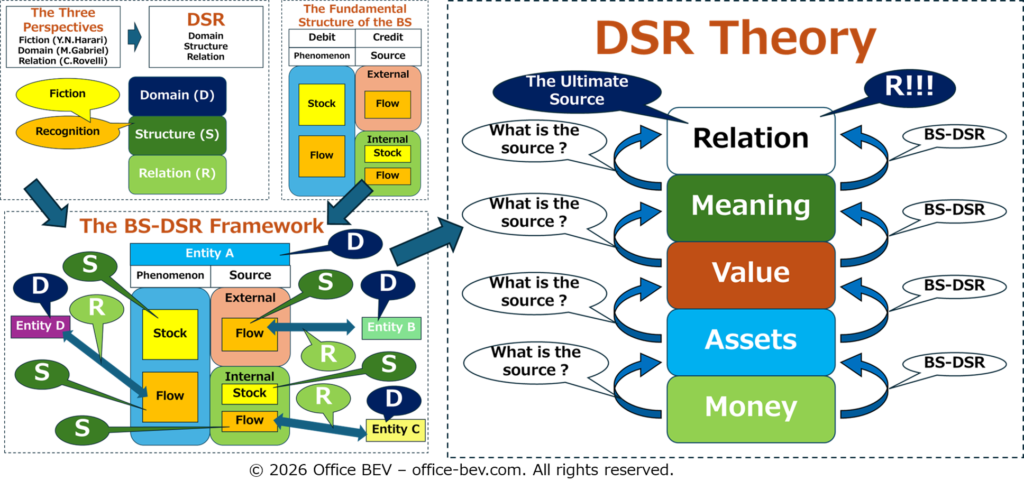
DSR Theory emerged in the course of exploring the nature of money through the BS perspective.
As this overview deepened, the inquiry progressively traced its way back toward its source—unfolding from Money to Assets, from Assets to Value, and ultimately from Value to Meaning.
As a fundamental structure that became visible through that process, DSR Theory places the following four questions at its core and aims to clarify the nature of each:
- How does Meaning arise?
- How does Value come into being?
- How do Assets increase or decrease, and how do they interlink and transform?
- What is Money, and where does it come from?
These contents are organized and continuously updated on the Structure Atlas.
About the “Atlas” Approach — Updating the Map, Rather Than Publishing a Serial
This series is not a conventional “serial” in which completed texts are published one after another.
Instead, the overall structure (the Atlas) is displayed on fixed pages, and the contents are accumulated by continuously updating the map.
The reason is simple.
Theory-building and structural analysis rarely proceed along a single straight line; rather, they require repeated reorganization and ongoing revision from a bird’s-eye perspective.
When exploring what money is through the BS perspective, the deeper the inquiry goes, the more structures become visible—and previously unseen paths and connections begin to emerge.
Updating the map along the way makes it easier to advance the inquiry while keeping the overall structure coherent.
The Atlas is therefore not a “final version,” but a living map that is updated as the project progresses.
This Atlas is not designed as a textbook to be read from top to bottom.
It is intended to be explored from any entry point of interest, with the option to return to the theoretical core whenever needed.
Overall Structure of the Atlas (Latest)
The Structure Atlas consists of two major parts.
Part I —— DSR Theory (Theoretical Foundations)
This part presents the core structure of DSR Theory.
It examines how Recognition, Meaning, and Value arise, and then connects these discussions to the question of the boundaries of AGI.
Part II: —— Structural Analysis Through DSR Theory (Applications)
This part applies the theory to a wide range of phenomena—such as Assets, Money, Government, and Markets—and interprets them structurally.
In particular, for Assets and Money, the BS perspective is used to capture their “movements” and “circulations” in concrete form.
Contents
The latest table of contents is summarized on the following page:
Contents
Part I —— DSR Theory (Theoretical Foundations)
- Preface: Author’s Position
- Chapter I — What Is DSR Theory?
- Chapter II — The Nature of Meaning (in progress)
- Chapter III — The Nature of Value (in progress)
- Chapter IV — The Boundary of AGI (in progress)
Part II: —— Structural Analysis Through DSR Theory (Applications)
- Chapter V — The Nature of Assets (planned)
- Chapter VI — The Nature of Money (planned)
- Chapter VII — The Nature of Government (planned)
- Chapter VIII — The Nature of Markets (planned)
- Chapter IX and beyond — Various Phenomena Through the BS-DSR Framework (planned)
