
Outline
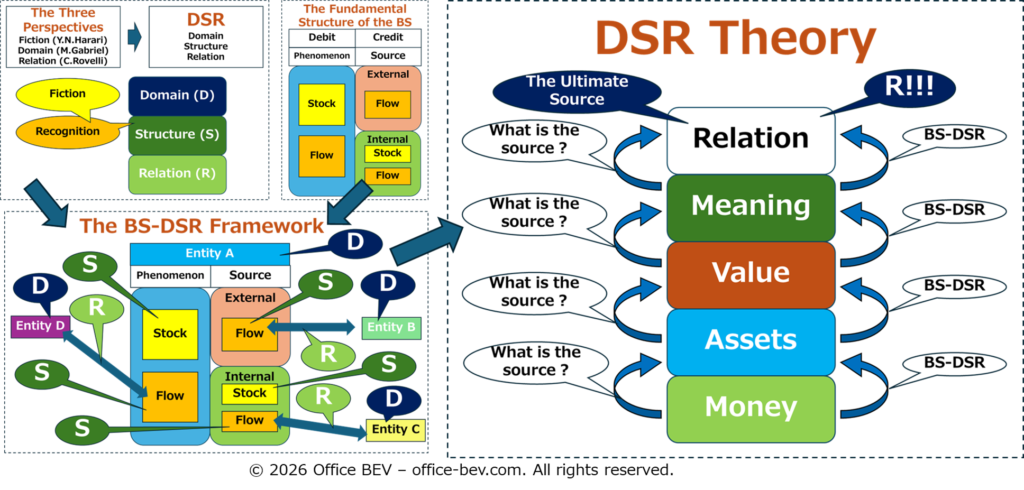
Detailed Structure
1. From Three Perspectives to DSR Theory
2. From Fiction to Recognition
3. From Recognition to Meaning
4. From Meaning to Balance
5. Introducing the BS (Balance Sheet) Perspective
6. What Is DSR Theory?
7. Introducing the BS-DSR Framework
8. The Significance of DSR Theory and Its Practical Framework (the BS-DSR Framework)
9. A Universal Framework for Capturing Diverse Phenomena
1. From Three Perspectives to DSR Theory
1) Three Perspectives for Reading the World
1.1) Fiction — Yuval Noah Harari
1.2) Domain — Markus Gabriel
1.3) Relation — Carlo Rovelli
2) From Three Perspectives to The BS-DSR Framework
3) The Path That Led to DSR Theory
3.1) Tracing the question “What Is Money?” through the BS-DSR Framework
3.2) Understanding the source of money requires a Bird’s-Eye View of Assets
3.3) A bird’s-eye view of assets reveals value
3.4) A bird’s-eye view of value reveals meaning as its source
3.5) This path culminated in the full DSR Theory taking shape
— BS-DSR Framework → Money → Assets → Value → Meaning → DSR Theory
4) The Scope of DSR Theory
4.1) An abstract framework for reading objects through three layers: Domain, Structure,
and Relation
4.2) A method for taking a bird’s-eye view of economic, social, natural phenomena,
and beyond, using a unified structural language
4.3) The Structure of the DSR Theory Corpus
- Preface: Author’s Position — reading phenomena simply, without reliance on
specialized knowledge
- Chapter I: What Is DSR Theory? — from Three Perspectives and the BS Viewpoint to
the introduction of the BS-DSR Framework
- Chapter II: The Nature of Meaning — The beginning of meaning lies in the
emergence of relation
- Chapter III: The Nature of Value — from meaning to value (planned)
- Chapter IV: The Boundary of AGI — boundaries among humans, animals,plants, and
AGI defined by self-generated and linguistic recognition (planned)
4.4) The Range of Inquiry Viewed through DSR Theory
- Chapter V: The Nature of Assets / Chapter VI: The Nature of Money
…… The original aim of constructing DSR Theory (planned)
- Chapter VII and Beyond: Extensions to diverse domains (planned)
2. From Fiction to Recognition
1) Harari’s “Fiction”
— The human capacity for language-based recognition(what only humans possess)
1.1) Is “Fiction” a “Lie”?
— The meaning of the term “fiction”
1.2) Fiction can be realized
— Fiction is the recognition of meaning, and meaning can become reality
2) Recognition — A Perspective That Takes Something As an Object
3) Before Recognition Arises
— The existence of undifferentiated “fluctuations” as natural phenomena and physical
properties
— At a stage where recognition has not yet arisen, undifferentiated fluctuations
appear in a diffuse manner
— At this stage, neither subject nor object, nor any relation, has yet arisen
4) The Arising of Primordial Recognition
— Recognizing Primordial Correspondence: “Something Is There”
4.1) The Boundary between “Nothing” and “Something”
4.2) “Something Is There” means — “Something Is recognized as being there”
4.3) The minimal condition for recognition
— The co-presence of a recognizing subject and a recognized object
— Subject = the perspective of recognition / Object = the object of recognition
4.4) Primordial recognition — the recognition of primordial correspondence
- Primordial correspondence exists between subject and object
- Correspondence between subject and object means “There is a self that recognizes
something”, or simply, “There is a self”
3. From Recognition to Meaning
1) Is “Something Is There” Already Meaning?
1.1) Primordial recognition – the arising of subject and object
1.2) Subject = the perspective of recognition / Object = the object of recognition
1.3) When the object has no gap—when it is purely singular, can anything be recognized?
— Thought experiment: what can be seen in a world of only yellow?
→ without any other colors, yellow cannot be recognized as “yellow”
1.4) “Something” cannot be recognized without the presence of “something else”
2) The Condition For Meaning To Take Shape — “Contrast” with Others
2.1) Explaining “Something” necessarily requires “Something Else”
2.2) Meaning necessarily seeks “contrast”
2.3) Contrast requires a “Gap” between something and something else
2.4) A “Gap” brings forth relation and balance between something and something else
3) The Source of Meaning = There Is a Gap – The establishment of relation and balance
3.1) Contrast arises only when there is a gap
3.2) Contrast across the two sides of a gap establishes relation and balance
3.3) Meaning appears as “difference” between the two sides of a gap
4) Meaning-Generation Process — How Meaning Appears
P0 Before Recognition — The Existence of “Fluctuations”
– Recognition has not yet arisen.
P1 The Arising of Primordial Recognition
= Recognizing Primordial “Correspondence”: “Something Is There”
– Subject recognition (and object recognition) = Self-recognition
P2 The Source of Meaning Appears = Primordial “Relation” Arises — “There Is a Gap”
– Relation arises as a prerequisite for meaning-generation
– Relation has arisen, but it has not yet tilted; no directionality has arisen
– Only the source of meaning has appeared; meaning itself has not yet appeared
P3 Recognizing a Vague Meaning
= An Open “Boundary” Appears = “Difference” Appears — “Something Feels Different”
– The source of meaning (gap / relation) begins to tilt
– A boundary exists, yet it remains open — it diverges
– The two sides of the open boundary feel different
– Difference exists, but it diverges and does not converge;
the difference is not yet clear
– Meaning remains vague
P4 Recognizing a Clear Meaning
= The Closure of a “Boundary” → The Establishment of a “Relation”
→ The Emergence of a “Domain”
– The inside closes; inside / outside become distinct,
and the scope of the inside becomes definite
– As the scope becomes definite, the divergence inside converges
– A relation is established between “the closed inside” and “the open outside”
– This inside–outside relation makes the inside stand out clearly as a domain
– The domain and the relation that supports it form a meaning-structure,
and meaning takes shape
<P2–P4 The Formation of the “Structure” of Meaning>
PC Transformation of Meaning “Structure”
— The Reappearance of “Boundary” and “Difference”: Two Typologies
(1) “Reopening and Divergence of a Closed Domain”
→ Transformation of Existing Meaning
– When the closed boundary and domain come under increasing pressure to transform
—due to external forces or internal change—the closed boundary is “opened”,
diverges again, and then closes in a changed form, transforming the existing
meaning into a new one.
(2) New Boundary Appears Within or Outside an Existing Meaning Structure
→ A New Domain Emerges → A New Meaning Take Shape
– A new boundary appears in the fluctuations that exist within or outside
an existing meaning structure, and ultimately,
a new meaning structure takes shape.
4. From Meaning to Balance
1) Primordial Recognition = Primordial Correspondence (Subject-Object)
— The Balance Between Subject and Object
2) The Source of Meaning = “A Gap” — The Balance Across the Two Sides of a Gap
3) Meaning Calls for “BS” (Balance Sheet)
5. Introducing the BS (Balance Sheet) Perspective
1) The Balance Sheet (BS) as the Space Where Recognition Takes Place
2) The Fundamental Structure of the BS (1): The Dual-Aspect Structure of Debit and Credit
— The Appearance of Assets and Their Source
3) The Fundamental Structure of the BS (2): The Two-Layer Structure of the Credit Side
— A Zero-Sum Relation Between Internal and External Sources
4) The Fundamental Structure of the BS (3): The Stock–Flow (SF) Structure
5) Why the Three Perspectives Align So Well with the Fundamental Structure of the BS
5.1) Fiction = Recognition :
– The SF Structure (3) Is Defined by the Presence or Absence of Recognition
5.2) Domains :
– The BS Makes Domains Explicit — Debit/Credit (1), Internal/External (2),
Single-Entity/Consolidated, and More
5.3) Relations :
– The BS Captures Diverse Relations — Debit–Credit (1), Claim–Obligation (3),
Investment–Capital (3), and More
6. What Is DSR Theory?
1) The Integration of the Three Perspectives and the Fundamental Structure of the BS
1.1) From the three perspectives to the DSR three layers — Domain, Structure, and Relation
1.1.1) The affinity between the three perspectives and the fundamental structure of the BS
1.1.2) From the three perspectives to the DSR three layers (Domain, Structure, and
Relation)
1.2) Describing the DSR three layers through the BS
1.2.1) Domain: what domain is it, and which entity does it belong to?
1.2.2) Structure: what does the object mean?
(Existence vs. Recognition / Self-Contained vs. Dependent)
1.2.3) Relation: Does the object have relations, and if so, with whom and what kind?
1.3) The DSR loop — the circulation structure of domain, structure, and relation
1.3.1) domain generates structure
1.3.2) structure generates relation
1.3.3) relation generates a new domain → recursive circulation
2) What Is DSR Theory?
- DSR theory is a framework that uses the BS-DSR frame (explained later) to describe an object
in terms of DSR (Domain, Structure, and Relation), thereby clarifying the object’s nature.
2.1) Domain:
a meaning space that serves as the framework in which an object is established and
relations are formed. It distinguishes the inside and the outside of the domain. It contains
structure and relation within itself.
2.2) Structure:
a framework that summarizes the arrangement of objects and relations within a domain,
and the pattern of interactions that emerges from that arrangement. It contains domains
and relations within itself.
2.3) Relation:
a structure of effects through which multiple objects influence one another within
a domain. It also refers to a structure of effects through which a domain and the objects
within it influence other domains and the objects within them. It contains domains and
structures within itself.
7. Introducing the BS-DSR Framework
1) The BS-DSR Framework
– a framework for analyzing an object by using the fundamental structure of the BS,
as a practical tool for DSR theory
1.1) Domain:
1.1.1) what BS is it?
1.1.2) whose BS is it? – single-entity / inter-entity / collective entity
1.2) Structure:
1.2.1) appearance / source (debit / credit) – what appears, and what is its source?
1.2.2) internal / external: is the source internal (self) or external (others)?
1.2.3) the SF structure: is the appearance/source stock-structured (self-contained)
or flow-structured (dependent)?
1.3) Relation:
1.3.1) self-contained or dependent
1.3.2) if dependent:
1.3.2.1) dependent on oneself – self-based dependence
1.3.2.2) dependent on others’ obligations(enforceable) – obligation-based dependence
1.3.2.3)dependent on others’performance(rule-governed)-performance-based dependence
1.3.2.4) dependent on others’ goodwill(voluntary) – goodwill-based dependence
2) The Abstract Structural Model (DSR Theory) and Its Concrete Embodiment (the BS-DSR
Framework)
2.1) DSR theory:
– a theory that describes any object through the three layers of Domain, Structure,
and Relation.
– It serves as an abstract model that captures the structure of the world.
2.2) the BS-DSR framework:
2.2.1) the BS is one of the most structurally transparent embodiments in the world.
2.2.2) key features of the BS:
2.2.2.1) domain is explicit: single-entity / inter-entity / consolidated
2.2.2.2) structure is explicit: debit/credit = appearance/source, internal/external,
and the SF structure
2.2.2.3) relation is explicit: receivable/payable, investment/capital, claim/obligation,
and more
2.3) the relationship between DSR theory and the BS-DSR framework:
– a hierarchical structure from an abstract model to a concrete embodiment
8. The Significance of DSR Theory and Its Practical Framework (the BS-DSR Framework)
1) An Abstract Theory That Extracts the Structural Principles Inherent in the BS and Generalizes
Them Beyond the Economic Field
– DSR theory extracts the structural principles inherent in the BS and generalizes them into
an abstract theory that can be applied to a wide range of phenomena beyond the economic
field.
2) Presenting the Structural Principles That Have Long Been Embedded in the BS but Have
Never Been Explicitly Articulated
– The BS has long been widely used in practice across the world, yet the structural principles
behind it have not been explicitly articulated. DSR theory extracts those principles and
presents them as a theoretical framework.
3) A Universal Framework for Interpreting the World Through Domain, Structure, and Relation
– DSR theory and its concrete embodiment, the BS-DSR framework, provide a methodology
for interpreting any phenomenon in the world through the three layers of Domain,
Structure, and Relation, thereby clarifying its Nature.
– Based on the BS-DSR framework, DSR theory offers a theoretical framework for taking a
bird’s-eye view of meaning, value, assets, and money, as well as social institutions and
structures.
9. A Universal Framework for Capturing Diverse Phenomena
1) The Scope of DSR Theory
— it is not a theory confined to a specific field, but an abstract framework for interpreting any
object through the three layers of Domain, Structure, and Relation.
— it makes it possible to view economics, society, recognition, and natural phenomena
through the same structural terms.
- the composition of DSR theory:
Chapter I: What Is DSR Theory?
— From the Three Perspectives and the BS Perspective to the Introduction of
the BS-DSR Framework
Chapter II: The Nature of Meaning
— The Beginning of Meaning Lies in the Emergence of
Relation
Chapter III: The Nature of Value
— From Meaning to Value (Planned)
Chapter IV: The Boundary of AGI
— How the Five Senses Draw the Line Between Humans, Animals, and AGI
(Planned)
2) Fields to Be Interpreted Through DSR Theory (Planned)
Chapter V: The Nature of Assets
Chapter VI: The Nature of Money
Chapter VII: The Nature of Government — From the Perspective of Money
Chapter VIII: The Nature of Markets
Chapter IX and Beyond: Diverse Phenomena Interpreted Through the BS-DSR
Framework
3) Re-Describing Natural Science (Physics), Epistemology, and AGI Through DSR Theory (Outlook)
— not as a replacement of existing theories or concepts, but as a possibility of re-framing them
structurally through DSR (Domain, Structure, and Relation).
3.1) wave–particle duality in quantum theory
— in physics, it describes the dual nature of quantum entities as waves and as particles.
— in DSR terms, “wave” may be viewed as a state in which relations remain open and unfold,
while “particle” may be viewed as a state in which relations close and appear as a structure.
3.2) the measurement problem in quantum mechanics
— in physics, it concerns why outcomes are not definite before measurement, yet become
definite when measurement occurs.
— in DSR terms, measurement may be re-described as an act that closes open relations
and stabilizes them as a structure.
3.3) the Planck length
— in physics, it is often described as a fundamental length scale at which the classical picture
of spacetime may break down.
— in DSR terms, it may be interpreted as the minimal resolution at which relations can
meaningfully be opened or closed, and difference can arise.
3.4) the Heisenberg uncertainty principle
— in physics, it is often formulated as a limit on how precisely certain pairs of quantities can be
specified at once.
— in DSR terms, it may suggest a trade-off in relational closure: closing one relation more
tightly tends to leave another more open.
3.5) Zeno’s paradoxes (infinite regress, infinite division, infinite approach)
— a classic set of paradoxes concerning motion and arrival.
— in DSR terms, as long as relations of influence or reaching a destination remain open and
never fully close, the state of being “still on the way” may continue indefinitely.
3.6) the many-worlds interpretation (of quantum mechanics)
— in physics, it is an interpretation in which all possible outcomes are realized in branching
worlds.
— in DSR terms, it may be understood as an appearance of endless branching of relational
configurations across domains.
3.7) implications for epistemology and AGI (structural insights)
— in current discussions, a central question is under what conditions genuinely self-generated
recognition can arise.
— in many accounts, if self-generated recognition is ultimately grounded in interaction with
an external environment, meaning generation may not be uniquely human.
— at the same time, it remains an open question whether an entity that lacks sensory input
(the five senses) or environmental interaction can enter a meaning-generating cycle
analogous to that of humans.
— in DSR terms, DSR theory may offer a way to approach epistemological questions
concerning self-generated recognition, embodiment, and sensory input in AGI.